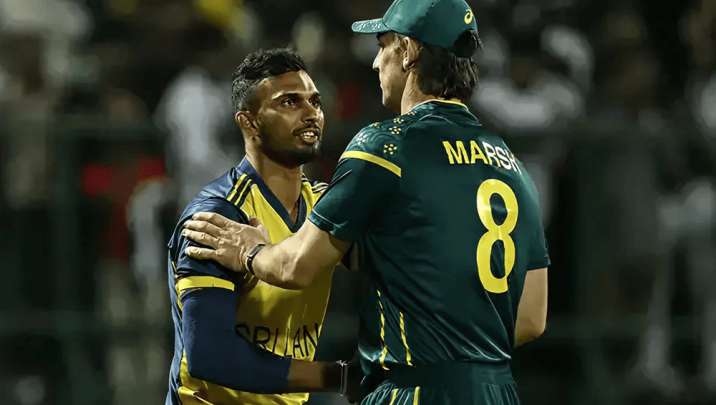
"At the start the way Australia was batting, everybody thought they will go beyond 220. But they were about 20 to 30 runs short," said Pathum Nissanka, the first centurion in the ongoing Men's T20 World Cup 2026, as he reflected on the Sri Lanka-Australia game.
Australia's innings was one of contrasting halves. The return of Mitchell Marsh provided an immediate boost, with the T20I captain joining forces with Travis Head to put Sri Lanka under early pressure. The former champions surged to 104 inside nine overs, seemingly setting themselves up for a massive total, before Sri Lanka's slower bowlers engineered a sharp turnaround led by Dushan Hemantha's three-wicket haul.
With Matheesha Pathirana leaving the field after just four deliveries because of discomfort in his left calf, the burden shifted to the rest of the attack. Hemantha, Maheesh Theekshana, Dunith Wellalage and Kamindu Mendis responded impressively, while Dushmantha Chameera backed them up with disciplined execution as Sri Lanka dragged the scoring rate down and restricted Australia to 180.
"I think it was probably just execution tonight, that full strength batting lineup has got some of the best players of spin in Australia. So it was probably more (about) just execution tonight," said Marsh at the press conference after the match. "I thought Sri Lanka pulled it back beautifully. We were a few short after the start. We probably knew that going into the second innings, but we had great belief that we'd get the job done, but we were outplayed."
"I guess we'll never know what would have happened if we made 220. We had a good platform, but we just weren't able to execute towards the back end. It's disappointing. Certainly not here to blame anyone, but yeah, we're a disappointed bunch... We knew we were going to face spin towards the back end, it slowed up a little bit, but again, just execution."
Sri Lanka, meanwhile, were methodical in the chase. After losing Kusal Perera early, Nissanka and Kusal Mendis stitched together a 97-run stand, with both batters bringing up fifties, to take the hosts to 104 for 1 after 12 overs. Although Australia eventually broke the partnership with the wicket of Mendis, they were unable to contain Nissanka, who shifted gears after the dismissal.
The outcome was a 52-ball unbeaten 100 for the opener, an unbroken 79-run stand off 34 balls between Nissanka and Pavan Rathnayake, and a Sri Lankan victory with two overs to spare.
"I thought tonight Nissanka just played brilliantly and take our situation and our team out of it. You take your hat off to someone when they score 100 off 50 balls in a World Cup match in a tight run chase at this stage of our group. So yeah, I take my hat off to him. And it was an incredible innings. And we didn't have many answers for him tonight," said Marsh.
Australia are now on the brink of an early exit after back-to-back losses to Zimbabwe and Sri Lanka. One more win for Zimbabwe, either against Ireland or Sri Lanka, would seal Australia's elimination.
When asked about the difference between the two innings, Marsh said: "I don't think there was much dew. I'm not sure if the wicket got better, I didn't feel that way. But I know that in these conditions, partnerships are incredibly important. If you look at the two innings outside of our opening partnership, we just weren't able to form a good one to get going again. So yeah, that's probably the difference in the game."
Nissanka explained the simplicity with which Sri Lanka approached the chase. He spoke in Sinhalese, and his translator said: "They were planning to bat normally for up to 12 overs and once they were actually batting up to 12 they realised that they were batting well and they were getting runs so they didn't really have to push it, and they were getting enough runs. They found it very easy, and they kept on discussing. But they never had to just go after the bowling."


